Filtered by: Research
6 October 2026
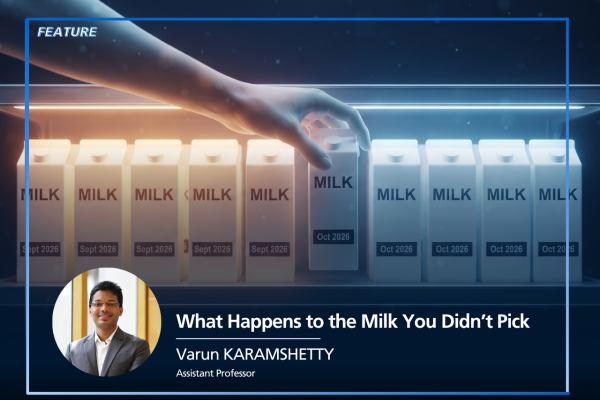
Picture the scene: you’re at the supermarket and two cartons of milk are on the shelf. One expires in three days, the other in five. You take the fresher one.
29 September 2026
In February 2024, an employee at engineering firm Arup joined a video call with people who looked, sounded and moved exactly like the company’s CFO and several colleagues. All of them were deepfakes. Over the course of the call, the employee authorised 15 wire transfers totalling US$25.6 million to accounts controlled by scammers, a case later confirmed by Hong Kong Police. The FBI’s Internet Crime Complaint Center recorded more than US$893 million in adjusted losses from AI-related fraud complaints in 2025, according to a report the agency published in April 2026.
21 September 2026
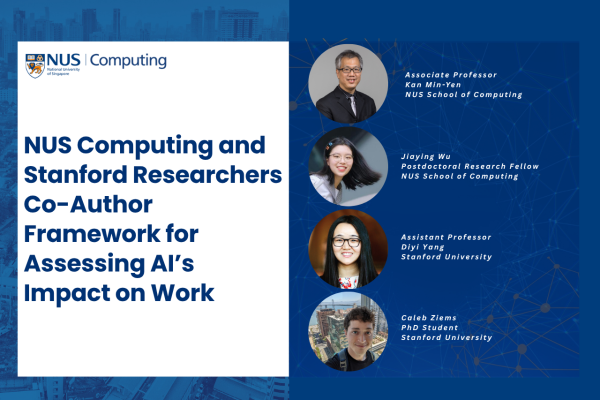
Researchers from NUS Computing, Stanford University and other institutions have co-authored a whitepaper setting out six conditions for judging whether AI genuinely improves work. The paper, “When Does AI Augment Work? A Workflow-Level Framework for Human-Agent Collaboration”, was posted to arXiv two days after the Ministry of Manpower told Parliament that its surveys show most firms adopting AI are redesigning jobs or creating new roles.
16 September 2026
A radio unit built entirely in software has earned Professor Chan Mun Choon and his team the Best Paper Award in Track 4 of IEEE International Symposium on Personal, Indoor and Mobile Radio Communications (PIMRC) 2026.

15 September 2026
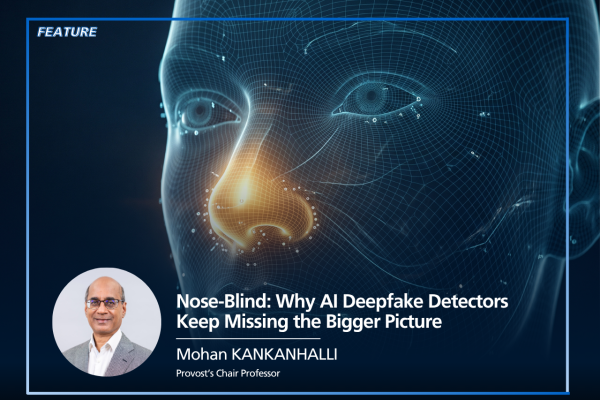
In February 2024, an employee at engineering firm Arup joined a video call with people who looked, sounded and moved exactly like the company’s CFO and several colleagues. All of them were deepfakes. Over the course of the call, the employee authorised 15 wire transfers totalling US$25.6 million to accounts controlled by scammers, a case later confirmed by Hong Kong Police. The FBI’s Internet Crime Complaint Center recorded more than US$893 million in adjusted losses from AI-related fraud complaints in 2025, according to a report the agency published in April 2026.
9 September 2026
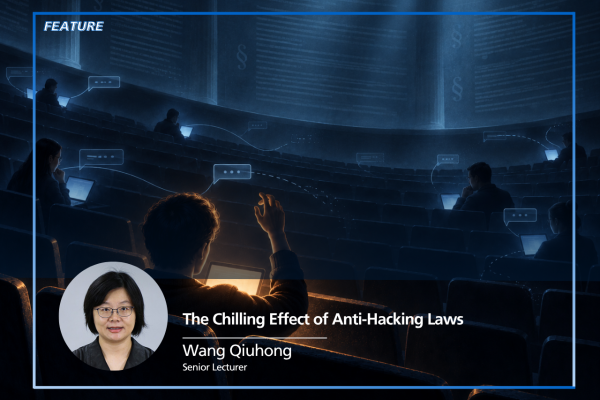
Every lock can be picked. That is roughly the logic of cybersecurity: to protect a system, you first have to understand how someone might break into it. The tools that test a network's weak spots are the same tools a criminal would use to exploit them. Encryption that keeps your bank details private is the same encryption that hides a ransomware gang's tracks.
9 September 2026
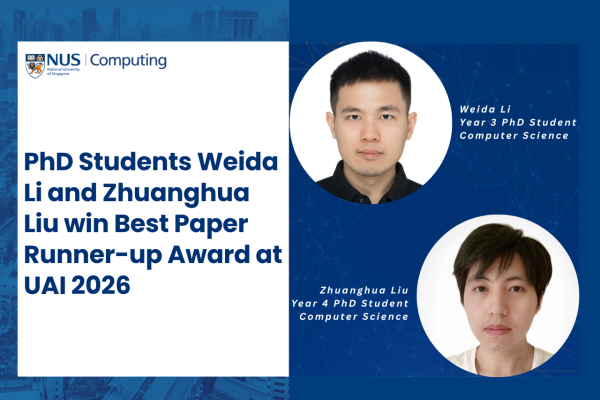
Two of our Computer Science PhD students, Weida Li and Zhuanghua Liu, have won the Best Paper - Runner-up Award at the Conference on Uncertainty in Artificial Intelligence (UAI) 2026 — ranking 2nd among 1,087 submissions to one of the top-ranked venues in AI research, working under the supervision of Associate Professor Bryan Kian Hsiang Low.
31 August 2026
Three papers co-authored by Professor Xiaokui Xiao have won top honours at leading international conferences this year, recognising work spanning AI system efficiency, differential privacy auditing, and graph algorithms.

27 August 2026
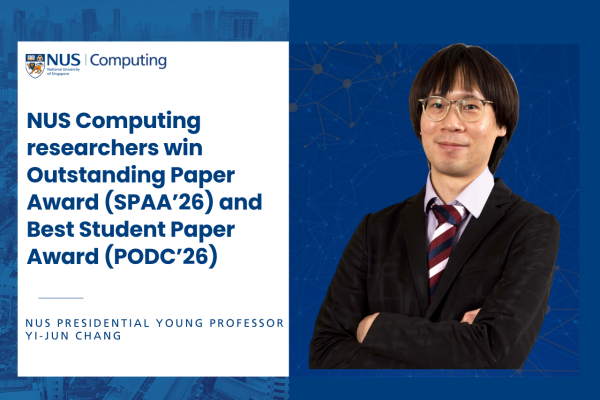
NUS Presidential Young Professor Yi-Jun Chang and his collaborators have won two awards at leading conferences in distributed computing this year: the Outstanding Paper Award at the 2026 ACM Symposium in Parallelism in Algorithms and Architectures (SPAA), given to the top three papers at the conference, and the Best Student Paper Award at the 2026 ACM Symposium on Principles of Distributed Computing (PODC), which recognises the best paper among those with substantial contributions from student authors.
19 August 2026
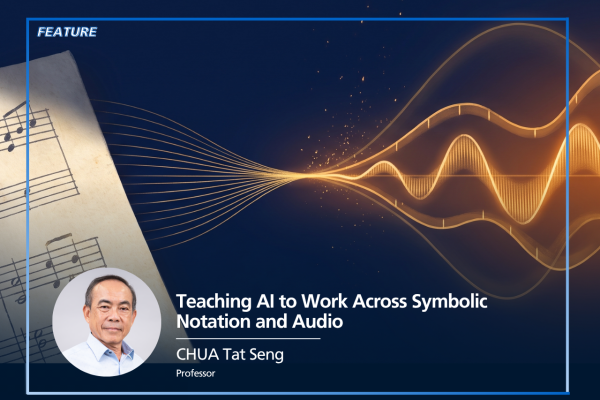
A best paper-winning model from NUS Computing helps AI learn from both written notation and recorded audio within a single framework, expanding how machines can understand music
18 August 2026
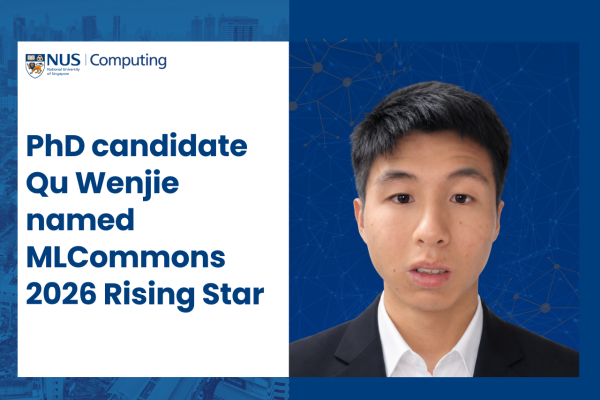
Qu Wenjie, a PhD candidate in Computer Science, has been selected as a 2026 ML and Systems Rising Star by MLCommons, an honour recognising early-career researchers shaping the future of machine learning and systems research.
17 August 2026
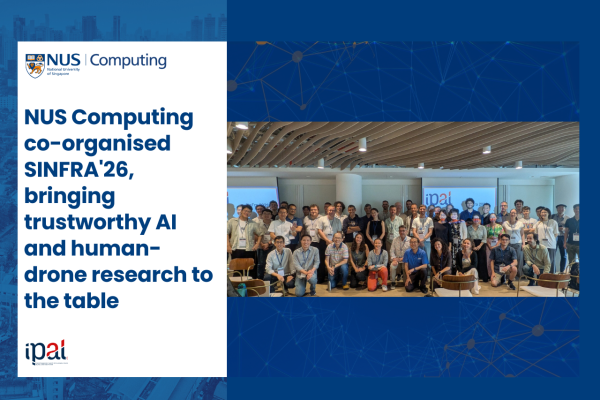
NUS School of Computing (SoC) co-organised this year's edition of SINFRA, the annual Singapore-France workshop on Computer Science and AI, bringing together more than 80 researchers from across the two countries' AI, robotics, and human-computer interaction communities.
12 August 2026
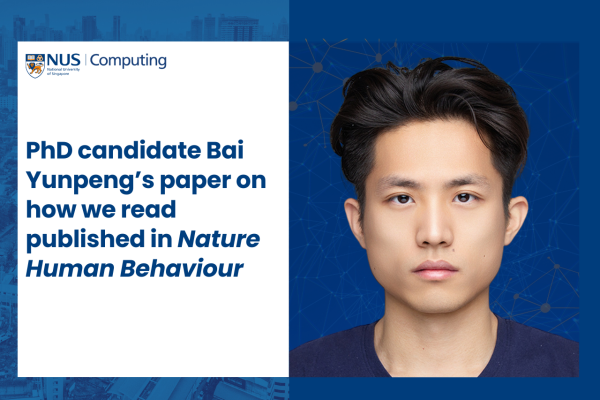
A paper by Bai Yunpeng, a PhD candidate at NUS Computing has been published in Nature Human Behaviour, one of the leading journals in the behavioural and cognitive sciences.
6 August 2026
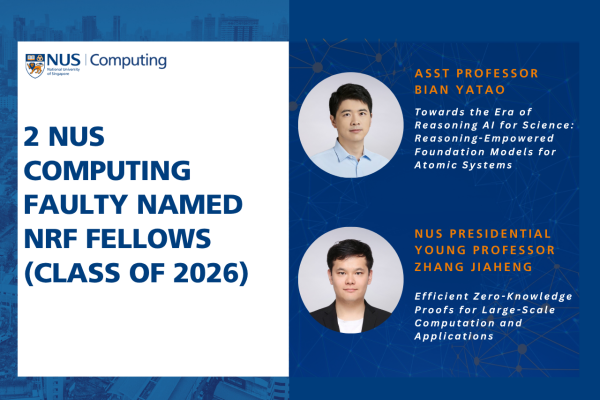
Assistant Professor Bian Yatao and NUS Presidential Young Professor Zhang Jiaheng have been awarded the National Research Foundation (NRF) Fellowship (Class of 2026), one of Singapore’s most competitive programmes for early-career researchers.
3 August 2026
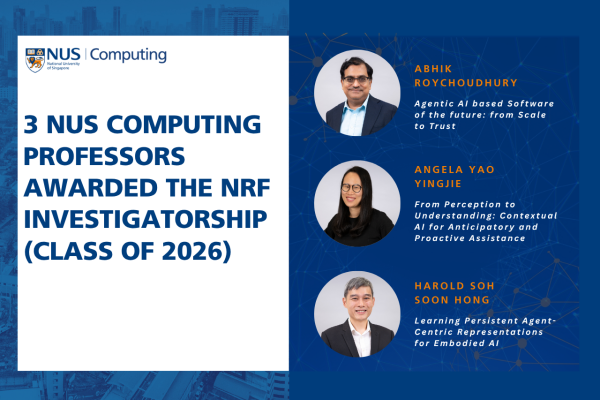
Three faculty members from NUS Computing have been awarded the prestigious National Research Foundation Investigatorship (NRF-I) under its 11th call, recognising their leadership and potential to drive high-impact research in artificial intelligence.
15 July 2026
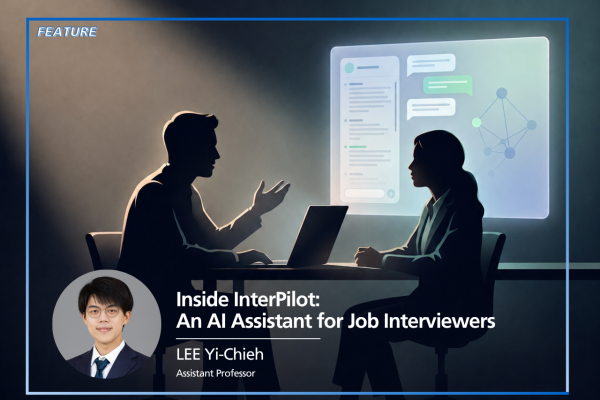
A hiring manager conducting a 15-minute interview is doing several things simultaneously: listening, evaluating, planning the next question, and writing it all down before it disappears. In a formative study of eight HR professionals, researchers from NUS Computing, together with collaborators from recruitment software firm Avature, found that participants put it plainly: "I need to try to remember everything, and also assess the candidate at the same time."
26 June 2026
Think about the last time you looked up a doctor online. Maybe you checked their credentials, read a few patient reviews, or noticed that they had answered hundreds of questions on a health Q&A platform – carefully, patiently, and in plain language. It probably made you feel more confident about seeing them.

11 June 2026
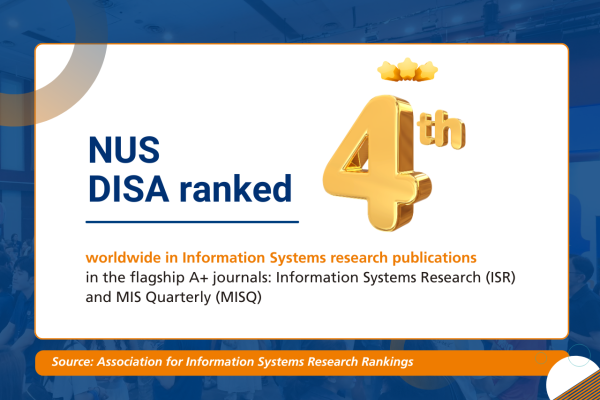
The Department of Information Systems and Analytics (DISA) at NUS Computing has been ranked 4th worldwide for research publications in Information Systems Research (ISR) and MIS Quarterly (MISQ) – the two most prestigious A+ journals in the field.
8 June 2026
The next time you search for a flight and watch the price jump $200 overnight, you might feel like the system is rigged against you. And you wouldn't be alone. Few things irritate travellers quite like the volatility of airline fares, that nagging sense that some algorithm, somewhere, is squeezing every last dollar from your wallet.

26 May 2026
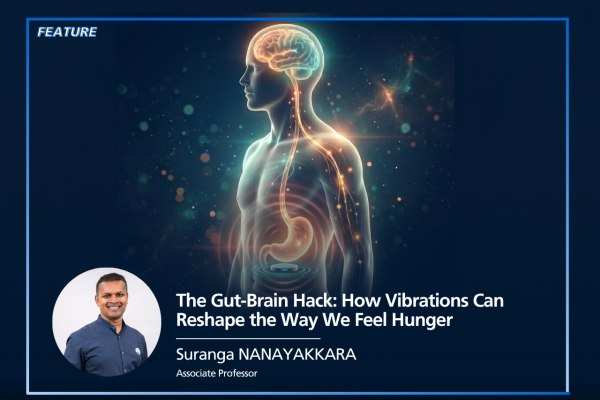
You've felt it before. That low, insistent rumble in your belly during a long meeting. The unsettling churn before a nerve-wracking presentation. We call these "gut feelings" – and while the phrase gets used loosely, science increasingly tells us they're anything but casual. The gut-brain axis, a two-way communication highway between the digestive system and the brain, shapes everything from appetite and mood to decision-making.